Portland’s commercial landscape is in continuous evolution. The city’s long history as a major Pacific Northwest commercial and industrial hub has left a built environment layered with structures from different eras of development Victorian-era brick commercial buildings in the Pearl District and Old Town, mid-century warehouses and industrial facilities in the Central Eastside and along the waterfront, post-war office and retail structures throughout the inner neighborhoods, and more recent mixed-use and commercial development that continues across the metro area. As land values shift, as older structures become functionally obsolete or physically deteriorated, and as redevelopment priorities change, Commercial Building Demolition Portland becomes a necessary phase in Portland’s ongoing urban transformation. Understanding what commercial building demolition in Portland actually involves its regulatory framework, its technical requirements, and the specific considerations that make Portland’s environment distinctive helps property owners and developers approach these projects with accurate expectations.
What Defines Commercial Building Demolition in Portland
Commercial building demolition encompasses the complete or partial removal of commercial, institutional, or industrial structures office buildings, retail facilities, warehouses, manufacturing plants, churches, schools, hotels, and the full range of non-residential building types that make up Portland’s commercial inventory. Portland City Code Chapter 24.55 defines demolition as the intentional destruction of a structure, and the Portland Bureau of Development Services requires a demolition permit for this work a permit that requires specific prerequisite documentation before it will be issued.
The scale and complexity of commercial building demolition vary enormously. A small single-story retail building of a few thousand square feet is a substantially simpler project than a multi-story office building, a large warehouse, or an industrial facility with embedded process infrastructure, underground tanks, and environmental contamination from decades of industrial operations. The approaches, equipment, timeline, and regulatory complexity all scale with the building’s size, structural type, and history of use.
Commercial demolition in Portland must be distinguished from deconstruction the manual disassembly of a structure for material salvage and from interior selective demolition, which removes specific interior elements while the building shell and structure remain standing. Portland’s Deconstruction Ordinance applies specifically to residential structures built before 1940; commercial buildings are not subject to the mandatory deconstruction requirement, though voluntary deconstruction of commercial structures with architecturally or historically significant materials is sometimes undertaken to recover value from the building’s fabric.
Oregon’s Regulatory Framework for Commercial Demolition
Oregon DEQ Asbestos Survey: Commercial Buildings of Any Age
The most consequential distinction between Oregon’s asbestos regulatory framework and the federal standard is Oregon’s requirement that ALL commercial buildings regardless of their construction date must have an asbestos survey conducted by an accredited inspector before any demolition or renovation activities. This is explicitly stated in Oregon Administrative Rule 340, Division 248, and confirmed by Oregon DEQ’s asbestos program documentation: “All commercial buildings regardless of construction date and residential buildings constructed before 2004 must have an asbestos survey conducted by an accredited inspector prior to any demolition or renovation activities.”
This requirement means that a commercial building constructed in 1999, in 2010, or even more recently must still have a full asbestos survey before a demolition contractor can proceed with structural work. While newer buildings are less likely to contain regulated asbestos-containing materials than those built before 1981, the Oregon DEQ requirement applies categorically. A copy of the asbestos survey report must be on-site during all demolition activities and must be provided to the DEQ upon request.
When the asbestos survey identifies regulated friable or non-friable asbestos-containing materials, the appropriate DEQ notification must be submitted and the abatement must be completed by a licensed contractor before structural demolition proceeds. For projects involving more than 10 square feet, 3 linear feet, or 3 cubic feet of asbestos-containing material, Oregon DEQ requires a 10-working-day advance notification through the DEQ’s online systems before abatement begins. Friable asbestos (material that can be crumbled by hand pressure) is subject to stricter handling requirements than non-friable asbestos, including the requirement that mechanical removal outside a full negative-pressure enclosure requires prior DEQ written approval.
Asbestos waste from Portland commercial demolition projects must be packaged in minimum double 6-mil plastic bags with appropriate asbestos hazard warning labels and DOT 9 hazard diamond labeling, transported with a completed Asbestos Waste Shipment Report Form (ASN-4), and disposed of at a DEQ-permitted landfill that accepts asbestos waste. Disposal facilities may have additional requirements and typically accept asbestos waste by appointment only.
Portland Permitting and Development Demolition Permit
Under Portland City Code Chapter 24.55, a demolition permit from Portland Permitting and Development (PP&D) is required before demolishing any commercial structure within the city. The permit will not be issued until PP&D has received the required asbestos survey documentation and, if regulated asbestos was identified, the close-out letter from the licensed abatement contractor verifying complete abatement.
Portland’s demolition permit process includes a review for structures that may be historically significant. If the structure being proposed for demolition is listed on or potentially eligible for the National Register of Historic Places, is a Portland Landmark, or is located in a local historic district, additional review through Portland’s Historic Resources program is triggered. This review can add significant time to the permit process and, in cases involving designated historic resources, may require consultation with the State Historic Preservation Office (SHPO) or other review bodies before a demolition permit is approved.
Utility disconnections are a prerequisite for commercial demolition that must be coordinated with multiple service providers. For commercial buildings, the utility disconnection scope may be substantially more complex than for residential structures: larger electrical service (often 3-phase service requiring coordination with Pacific Power or Portland General Electric), natural gas mains, water and sewer service through Portland Water Bureau, fire suppression system connections, telecommunications infrastructure, and in many cases specialty utilities such as steam, chilled water, or process utilities specific to the building’s commercial use. Written confirmation of each utility’s disconnection is required as part of the permit documentation.
Environmental Site Assessment and Contamination Considerations
For commercial buildings with histories of industrial, manufacturing, or chemical-handling use a significant portion of Portland’s commercial and industrial building inventory in the Central Eastside, the industrial areas along the Columbia Slough, and the former manufacturing corridors of inner Portland environmental site assessment is a critical component of pre-demolition planning. Phase I Environmental Site Assessments (ESAs) evaluate the property’s use history to identify potential recognized environmental conditions (RECs) situations where hazardous substances may have been released to the soil or groundwater. When Phase I assessment identifies RECs, a Phase II investigation may be needed to characterize the actual extent of contamination.
Buildings with environmental contamination histories may have contaminated soil beneath them, contaminated floor drains and sump systems, asbestos-insulated process equipment beyond the building fabric, PCBs in electrical transformers, underground storage tanks (USTs) with associated soil contamination, and other environmental conditions that must be addressed as part of or before demolition. Oregon DEQ’s cleanup programs including the Voluntary Cleanup Program (VCP) provide a framework for characterizing and addressing contamination at former industrial sites in Portland through the brownfield redevelopment process.
Portland’s location within the Portland Harbor Superfund Site area which encompasses a significant stretch of the Willamette River and adjacent properties creates specific environmental considerations for commercial demolition projects near the river. Properties within or adjacent to the Superfund area may have additional reporting requirements and may be subject to specific cleanup standards under the Superfund remediation framework.
Commercial Demolition Methods Used in Portland
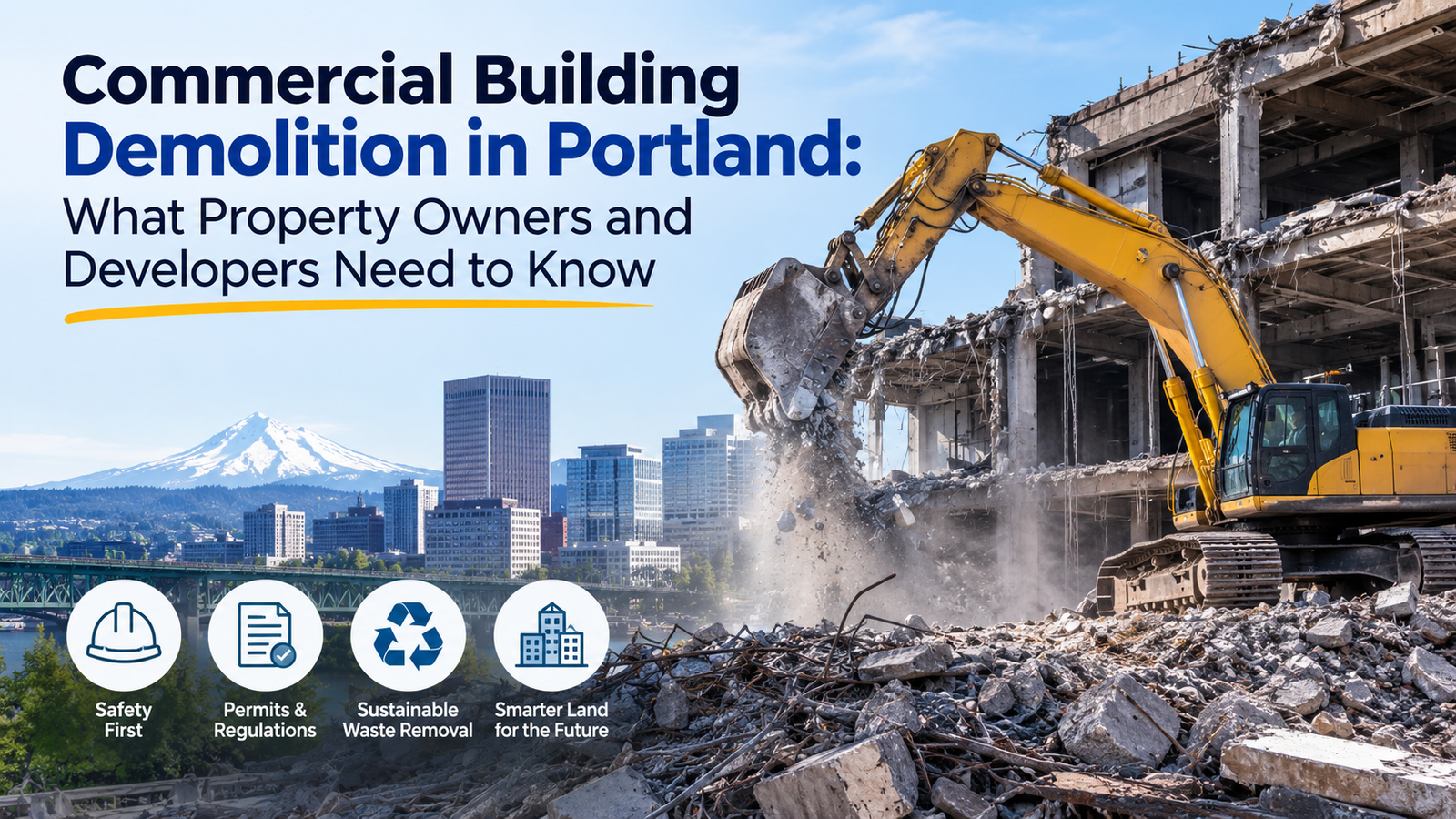
Mechanical demolition with excavators is the standard approach for most Portland commercial building demolitions. Excavators in the 20-to-100-ton range, equipped with demolition grapple, shear, or standard bucket attachments, systematically break apart and remove commercial structures, beginning at the roof and working progressively downward. For multi-story or taller structures, high-reach excavators with extended boom configurations allow top-down demolition without requiring workers at elevation in the fall zone of the demolition.
Portland’s inventory of commercial building types presents specific demolition considerations. Unreinforced masonry (URM) buildings Portland has a significant inventory of older brick commercial structures, many of which have been identified in the city’s seismic vulnerability assessments require careful sequencing during demolition because URM walls can be unpredictable in their collapse behavior when structural support is removed. Portland’s Bureau of Development Services and engineering judgment by the demolition contractor guide the sequencing of URM demolition to manage safety and debris control.
Tilt-wall concrete construction increasingly common in Portland’s commercial and industrial building stock for warehouse, distribution, and light industrial applications requires planned panel toppling sequences. The large, heavy concrete panels must be toppled in a coordinated sequence that manages the direction of fall and the resulting debris footprint, avoiding uncontrolled collapse and protecting adjacent structures, site equipment, and utility infrastructure.
Pre-engineered metal buildings (steel-frame construction with metal panel cladding), which are common throughout Portland’s commercial and industrial zones, can often be dismantled rather than mechanically demolished when the structural connections are accessible. Dismantling generates clean, separated steel that moves directly to scrap recycling a more efficient and economically favorable outcome than mixed demolition debris. The structural steel salvage value from large pre-engineered metal buildings can be substantial and partially offsets demolition cost.
Debris Management for Portland Commercial Demolition
Commercial building demolition in Portland generates several distinct material streams that are managed differently under Oregon’s regulatory framework and through the region’s recycling infrastructure. Structural steel and reinforcing steel are separated and recycled through Portland’s active scrap metal market. The value of structural steel in a large commercial demolition can be significant for a building with substantial steel content, the scrap value recovered from demolition may meaningfully offset the overall project cost.
Concrete and masonry from Portland commercial demolitions are routinely recycled as crushed aggregate at processing facilities throughout the metro area. The volume of concrete from a large commercial building can run to hundreds or thousands of tons the recycled aggregate produced serves as road base, fill material, and aggregate for new concrete applications throughout the regional construction market. Diverting this material from landfill reduces disposal costs and provides a productive second use for the material.
Wood, roofing materials, glass, and general demolition debris that cannot be economically recycled go to permitted transfer stations and disposal facilities in the Portland area. Metro’s South Transfer Station and other regional facilities accept commercial demolition debris, with material recovery operations that capture additional recyclable content from mixed loads before final landfill disposal.
The Commercial Demolition Timeline in Portland
Property owners and developers planning commercial building demolition in Portland should build their schedules around the realistic sequence of prerequisite and permit steps that precede physical demolition. A realistic timeline for a straightforward commercial demolition one without historic preservation complications, significant environmental contamination, or regulatory appeal processes might look like this: asbestos survey (one to two weeks for physical inspection plus lab analysis); if regulated asbestos is found, DEQ notification and 10-working-day waiting period followed by abatement completion and closeout letter preparation (two to eight weeks depending on abatement scope); Portland PP&D demolition permit processing (two to four weeks from complete application submission); physical demolition and debris removal (one to four weeks for most commercial buildings, longer for larger structures). Total elapsed time from project initiation to completed site can reasonably be estimated at eight to twenty weeks for a typical Portland commercial demolition, with significant variation based on the factors described above.
Historic preservation review, when triggered, can substantially extend this timeline. The review process for a Portland Landmark designation or potential National Register eligibility determination may take months, and in cases where the historic review results in conditions on the demolition permit, additional time may be needed to satisfy those conditions before physical demolition can proceed.
What Happens After Commercial Demolition in Portland
A completed commercial demolition in Portland leaves a cleared site that must be properly managed and prepared for its next use. Oregon’s stormwater permit requirements particularly the NPDES Construction General Permit administered by Oregon DEQ apply to disturbed sites above one acre, requiring a Stormwater Pollution Prevention Plan (SWPPP) and implementation of erosion and sediment control measures. Portland’s local stormwater management requirements may apply to smaller disturbances as well.
The cleared site’s subgrade must be evaluated for its suitability for the intended redevelopment. Underground infrastructure from the demolished building floor drains, sump pits, utility vaults, underground storage tanks must all be properly decommissioned and addressed. Foundation removal depends on the redevelopment plans: building a new structure typically requires complete removal of existing foundations and proper engineered fill of the excavation; some surface-use conversions may allow existing foundations to remain with appropriate documentation.
Common Questions About Commercial Building Demolition in Portland
Does Oregon’s asbestos survey requirement apply to recently constructed buildings? Yes. Oregon DEQ’s rule requires asbestos surveys for all commercial buildings regardless of construction date before demolition. While newer buildings are unlikely to contain regulated asbestos, the survey requirement is categorical. A licensed accredited inspector must perform the survey and produce a report before demolition proceeds.
What is the difference between a demolition permit and an asbestos abatement permit in Oregon? A demolition permit is issued by Portland Permitting and Development and authorizes the physical demolition of the structure. The asbestos abatement process including DEQ notification and contractor licensing is administered by Oregon DEQ separately from the building department permit system. Both processes must be properly completed: DEQ asbestos requirements are satisfied through the DEQ notification and abatement documentation, and PP&D requires evidence that asbestos requirements have been met before issuing the demolition permit.
Can a commercial building in Portland be demolished for voluntary reasons, or only when required by condition? Yes. Property owners can voluntarily demolish a commercial building for any legitimate redevelopment purpose. Demolitions ordered by a government agency due to structural unsoundness or imminent collapse must still meet asbestos requirements but may qualify for expedited DEQ approvals under specific emergency procedures.
How does Portland’s historic preservation program affect commercial demolition permits? If the structure proposed for demolition is a Designated Portland Landmark, is listed on or potentially eligible for the National Register of Historic Places, or is located in a local historic district, Portland Permitting and Development will require historic resources review before issuing a demolition permit. The outcome of this review varies from simple documentation to conditions on the permit, to in some cases denial of the demolition permit for the most significant historic resources.